Press
Download the educational resource “Feminist Proposals for Anti-Sexist (Un)Learning”
The educational material developed by the Disonancias Project and the Diversity and Gender R&D+i Hub is now available for free download. The document presents key concepts to reflect on anti-sexist education, along with activities that offer practical applications.
April 25, 2025
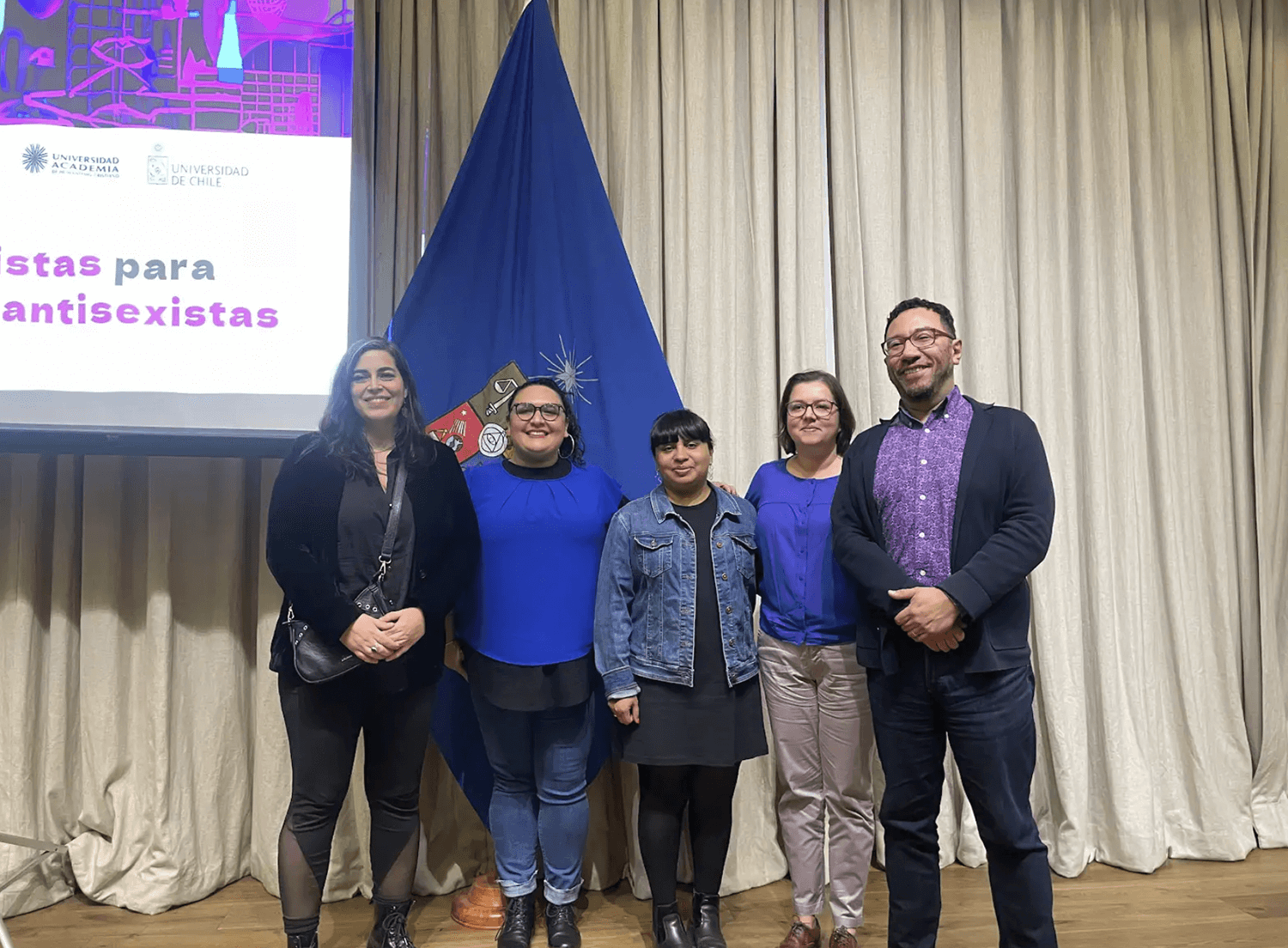
Lelya Troncoso, Marcela Bornard, Rosario Olivares, Carolina Muñoz y Pablo Astudillo.
On Tuesday, April 22, at the Main Campus of the Universidad de Chile, the launch of the educational resource Feminist Proposals for Anti-Sexist (Un)Learning took place. This initiative was developed by the Anillo ATE220009 Disonancias - "Dissonances: Community, University and Feminist Irruption" and the R&D+i Hub “Diversity and Gender: Intersectional Feminist Approaches” from the Department of Social Work at the Universidad de Chile.
The material stems from work carried out with public schools and municipalities throughout 2024. It explores core concepts related to anti-sexist education and provides practical and participatory activities designed to explore these ideas. These can be adapted to different contexts and needs. The resource is divided into four sections: Anti-Sexist Education and Feminist Pedagogies, Gender and Sexuality, Masculinities, and finally, Community, Violence, and Transformation.
During the launch, Professor Lelya Troncoso—Associate Professor at the Faculty of Social Sciences at the Universidad de Chile, coordinator of the Diversity and Gender Hub, and associate researcher of the Disonancias Project—outlined the creation process and the aims of the material, emphasizing the importance of creating horizontal spaces for dialogue and active listening within education.
“This material is an invitation to create spaces for conversation. These don’t have to be limited to training sessions where someone presents a law against violence or explains definitions or concepts. What’s truly important is having workshop spaces where we can connect with people’s lived, embodied experiences—spaces where this knowledge is felt through the body and where disagreement can also emerge,” said Dr. Troncoso.
The event also included a panel discussion featuring key figures from the education sector: Marcela Bornand, Director of the Liceo Experimental Manuel de Salas; Pablo Astudillo, academic at the Universidad Alberto Hurtado; and Rosario Olivares, coordinator of the InES Gender program at the Universidad Metropolitana de Ciencias de la Educación. The panelists highlighted the manual’s intersectional approach and its potential to bring its content into educational spaces beyond the classroom. They also praised the variety of included activities, such as an arpillera workshop designed to create a space for memory, reflection, and collective creation around experiences of violence, and an activity for reflecting on gender stereotypes linked to masculinities, among others.
“Today, communities have a deep need to talk again, to reconnect—even through disagreement—but from new logics that challenge the traditional educational model. That model carries with it embedded power dynamics and patriarchal structures, which must be addressed through different pedagogical practices,” said Professor Bornand during the event.
The launch gathered over 80 attendees, including students, teachers, researchers, and activists. It was conceived as a space for collective reflection around the challenges of confronting sexism in education from a feminist and intersectional perspective. Attendees had the chance to share experiences from their own educational contexts and ask questions that fostered collective reflection.
This pedagogical proposal aims to provide tools for opening critical conversations in educational settings, promoting processes of (un)learning that question the gender order and the power structures that sustain it.
The educational material Feminist Proposals for Anti-Sexist (Un)Learning is available for free download. In the coming months, a new launch event will be held in the city of Valparaíso.